Best Heavy Duty Garage Shelves With Wheels
Buy heavy duty garage shelves with wheels only when the rated wheel load covers your real storage weight. Check the caster rating, not just the shelf rating, then match wheel size to your floor and depth to your walkway.
On this page (8 sections)
- How do caster ratings change what heavy duty garage shelves with wheels can hold?
- Why 3-inch casters are the practical minimum for a loaded garage rack
- How wide and deep should rolling garage shelving be?
- Which pick suits your garage?
- How do you keep a loaded wheeled rack stable and safe?
- What should you check before you buy heavy duty garage shelves with wheels?
- How much floor space do these racks need to move?
- Which rack should you pick?
The best heavy duty garage shelves with wheels are the ones whose caster rating covers your real load, not the shelf rating printed in big type. A rack sold as 1,400 lb may carry only 440 lb when it stands on wheels and 88 lb per shelf when rolling.
That gap is the whole buying decision. A wheeled rack that feels solid empty can buckle at the joint once you stack paint cans or tool cases on it.
Start with the wheel load, then work back to width, depth and floor type. The three picks below show how that math changes with size, and the first suits most garages.
Our heavy duty metal shelving guide covers the fixed-foot versions if you never plan to move the rack.
How do caster ratings change what heavy duty garage shelves with wheels can hold?
The caster rating is the real limit on a wheeled rack. A shelf rated at 350 lb per tier on leveling feet may carry only 110 lb per tier on wheels at rest and 88 lb while rolling.
Makers publish two or three load figures for the same unit because the feet and the wheels carry weight differently. Fixed feet spread load straight down through the posts, while casters concentrate it on four small contact patches and add sideways force whenever the rack moves.
That is why a rack sold as heavy duty can still be light duty once it rolls. Use the lowest published figure, the rolling load, as your working limit.
If the rack will mostly sit still and only move twice a year, the standing wheel rating is the number to watch.
Reading the load table correctly
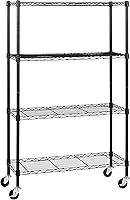
Take the Amazon Basics 4-Shelf Rack on Casters as the example. Its published figures are 350 lb per shelf and 1,400 lb overall with leveling feet.
On wheels not in motion those drop to 110 lb per shelf and 440 lb overall. With wheels in motion, 88 lb per shelf and 353 lb overall.
The same pattern appears on bigger racks. The REIBII 60-Inch unit carries 2,399 lb on its feet but rolls at 661 lb, and the 55-Inch 3000 lb Shelving is rated as a whole at about 3,000 lb.
Decide your real load before you buy. Weigh or estimate the heaviest tier, not the total.
A rack that holds 88 lb per shelf is fine for paint cans and hand tools and wrong for engine blocks.
Set your working limit at the rolling figure, then keep the heaviest items on the bottom shelf so the rack stays stable when you push it. A top-heavy rolling rack is the most common way these units tip.
Why 3-inch casters are the practical minimum for a loaded garage rack
Wheel diameter decides how easily a loaded rack crosses the floor. Three inches is the smallest size worth buying for a garage, and all three picks here use 3-inch casters.
Smaller casters catch on expansion joints, grit and the lip of a garage door. A 2-inch wheel needs a hard shove to start moving and transmits every bump up through the shelf, which shakes the load.
A 3-inch wheel rolls over most smooth concrete seams without that jolt. Bigger casters, 4 or 5 inches, roll even more easily but raise the rack and cost more, so 3 inches is the sweet spot between effort and stability for a home garage with a smooth slab.
Locking wheels and swivel action
A caster that swivels lets you steer the rack into a corner or turn it sideways for cleaning. Swivel casters also make a wide rack harder to push in a straight line, so check how many wheels lock.
The REIBII 60-Inch unit uses four 3-inch industrial-grade swivel wheels, two of them lockable. That pairing lets you roll the rack out for sweeping and lock it back in place.
The Amazon Basics rack ships with 3-inch caster wheels and separate leveling feet. The 55-Inch 3000 lb Shelving uses a wheel design with two brake wheels for stability at rest.
Lock at least two wheels before you load or unload, and set the brakes any time the rack sits on a slope.
Buy a rack with at least two locking casters, and prefer four if the floor is not perfectly flat. A rack that cannot lock will creep when you lean on it.
How wide and deep should rolling garage shelving be?
Width and depth set how much you store and how easily the rack moves. A 60-inch rack fits two 27-gallon totes side by side per shelf; an 18-inch depth leaves a walkway in a one-car garage.
Wider racks hold more but are heavier to turn and harder to steer around a parked car. Narrower racks fit tight aisles and are easier to reposition alone, so measure your aisle and the turning space before you choose width.
Depth is the bigger trade-off. An 18-inch-deep rack holds totes and boxes well but juts into the walkway.
A 14-inch-deep rack tucks closer to the wall and suits narrower spaces. A 23.6-inch-deep rack holds bulky gear but needs more floor.
Matching depth to your garage layout
A one-car garage with a workbench down one side often has only a narrow strip left for storage. A 14-inch rack fits that strip without blocking the path to the car.
Our garage shelving with wheels comparison covers narrower units if floor space is tight. A two-car garage with a clear back wall gives you room for an 18-inch or deeper rack, and deeper shelves let you store paint cans two rows back and keep the aisle clear.
Check the rack's minimum door width if you plan to move it between rooms. A 60-inch rack needs a 60-inch opening to pass through, so a wide unit may be stuck in one bay.
Measure your aisle, not just your wall. A rack that fits the wall but blocks the door to the house is the wrong size no matter how much it holds.
Which pick suits your garage?
The right rack depends on how much you store, how often you move it and how much floor space you can spare. These three cover the common cases from light household gear to heavy shop loads.
Our score weighs specs, features and buyer feedback against what you're shopping for. The best overall pick is the highest score, and the others are best for a named need.
Amazon Basics 4-Shelf Rack on Casters: best overall for most garages
The Amazon Basics rack is the best pick for most people because it balances capacity, footprint and price tier without forcing a choice between wheels and feet. It ships with both, so you can roll it or set it solid.
At 36 x 14 x 57.75 inches it fits a narrow strip beside a car and rolls out for sweeping. The four shelves adjust in 1-inch steps, and the whole unit assembles without tools.
Its load figures are the ones to remember. On leveling feet it carries 350 lb per shelf and 1,400 lb overall.
On wheels not in motion that falls to 110 lb per shelf and 440 lb overall, and while rolling to 88 lb per shelf and 353 lb overall.
Those numbers suit paint cans, hand tools, cleaning supplies and boxed household gear. They do not suit a full tool chest or engine parts.
Keep the heavy tier at the bottom and lock the wheels before loading.
Choose it for everyday garage storage where the rack moves occasionally for cleaning. Skip it if your shelves will hold dense shop equipment.
REIBII 60-Inch Wire Shelving With Wheels: best for a one-car bay
The REIBII 60-Inch unit is best for a one-car garage that needs a big, mobile bay without losing the walkway. Its 60 x 18 x 65.5-inch frame holds two 27-gallon totes side by side on each tier.
It is the strongest rolling rack here when loaded. The four feet carry 2,399 lb and the rack still rolls at 661 lb.
That means a shelf of paint cans and tool cases rolls out for sweeping without unloading first. The 65.5-inch top shelf sits at shoulder height, so weekly bins stay reachable without a step stool.
Four 3-inch swivel wheels, two lockable, handle repositioning, and four adjustable feet level it on uneven concrete. Assembly takes about 10 minutes with no tools, and the rack breaks down the same way for a move.
REIBII says the powder coating is baked on rather than sprayed, which helps it resist garage humidity and temperature swings.
Choose it when you want real capacity on wheels. Skip it if your aisle cannot take 18 inches of depth or you need a narrower footprint.
Our plastic shelving for garage guide covers lighter, cheaper options if this is more rack than you need.
55-Inch 3000 lb Shelving With Wheels: best for heavy shop loads
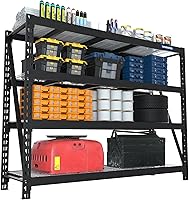
The 55-Inch 3000 lb unit is best for a workshop or garage that stores heavy machinery and industrial materials. Its 55 x 23.6 x 75.5-inch frame is rated as a whole at about 3,000 lb.
That rating covers the rack as a whole, not per shelf, so spread heavy items across tiers rather than piling them all on one. The four shelves adjust up and down, so you can set a tall bay for bulky gear and lower tiers for dense stock.
The 23.6-inch depth holds more than the other two picks and suits large boxes and equipment. It also takes more floor space, so this rack needs a dedicated wall rather than a leftover strip.
A wheel design with two brake wheels keeps it stable at rest. Assembly needs simple tools and instructions, and the powder-coated steel resists scratches.
At 120 lb empty, it is heavy enough that moving it alone takes care.
Choose it for dense, heavy storage where capacity matters more than a tight footprint. Skip it if you need to steer a rack around a packed one-car bay or fit a narrow aisle.
How do you keep a loaded wheeled rack stable and safe?
Stability comes from load placement and wheel locks, not from the rack's size. Keep the heaviest weight on the lowest shelf and lock the wheels before you load or unload.
A wheeled rack tips when the center of gravity rises too far. Put tool cases, paint and dense boxes low, and save the top shelf for light bins and empty containers.
This matters more on wheels than on feet because the rack can move under a leaning load. Lock at least two casters, and all four on a sloped or uneven floor, and chock the wheels if the slab slopes noticeably.
Push from the frame rather than the top shelf, and never pull a loaded rack toward you over a threshold.
Keep the rolling load within the rated figure. If a shelf feels heavy to push, it is over the rolling limit or the wheels are catching on debris, so sweep the path first.
Checking the floor and the path
Smooth concrete is the best surface for casters. Cracks, expansion joints and grit catch small wheels and can stop a loaded rack mid-push, so sweep the route before you move a full rack.
A garage door threshold is a common snag. Push slowly over the lip and keep the load low so the rack does not tip when a wheel stalls.
For a rack that stays put most of the time, the feet are the safer base. Check that the rack clears the garage door as it opens and that no overhead storage hangs into the path.
Our garage storage shelves heavy duty roundup covers fixed units if stability matters more than mobility.
Treat a wheeled rack as a moving load, not furniture. Lock it, load it low and keep the path clear.
What should you check before you buy heavy duty garage shelves with wheels?
Check five things in order: the rolling load rating, the caster size, the shelf depth, the rack width and whether feet are included. The rolling figure is the one that keeps you safe, and the rest decide fit.
Start with the lowest load figure. If it covers your heaviest tier, the rack is a candidate, so confirm 3-inch casters and at least two locks next.
Then measure your aisle and the rack's depth. An 18-inch rack is a good default for a one-car bay; 14 inches suits narrow strips and 23.6 inches suits heavy shop loads.
Check width against your door opening if the rack may move rooms. Finally, decide whether you want feet: a rack with both wheels and leveling feet, like the Amazon Basics unit, gives you the option to roll it or set it solid.
Quick comparison of the three picks
| Pick | Size (W x D x H) | Load on feet | Load on wheels | Best for |
|---|---|---|---|---|
| Amazon Basics 4-Shelf | 36 x 14 x 57.75 in | 1,400 lb | 440 lb still, 353 lb rolling | Most garages |
| REIBII 60-Inch | 60 x 18 x 65.5 in | 2,399 lb | 661 lb rolling | One-car bay |
| 55-Inch 3000 lb | 55 x 23.6 x 75.5 in | About 3,000 lb | Two brake wheels | Heavy shop loads |
Buy the rack whose rolling rating covers your real load, then size it to your floor. If the numbers are close, size up or move the heaviest items to a fixed shelf.
How much floor space do these racks need to move?
A wheeled rack needs its footprint plus turning room and a clear path. Allow the rack's depth plus about a foot in front for you to stand and push, and keep the route to the door clear.
The 36-inch Amazon Basics rack needs a 36-inch strip and rolls out easily. The 60-inch REIBII rack needs a full 60-inch opening to pass a doorway and more room to turn.
The 55-inch unit needs 23.6 inches of depth plus walkway. Measure the turning circle at the garage door, since a wide rack cannot pivot in a narrow bay, so you may need to pull it straight back and steer with the swivel casters.
Lockable wheels help you park it at an angle without rolling. Clear overhead space for the tallest shelf and any bins on top, because a 75.5-inch rack leaves little headroom under a low garage ceiling, so check before you load the top tier.
Plan the path before the purchase. A rack that rolls but cannot turn is stuck in place just as firmly as one on feet.
Which rack should you pick?
Pick the Amazon Basics 4-Shelf Rack on Casters for most garages, because its 440 lb standing wheel rating and 14-inch depth fit everyday storage without blocking the aisle. Pick the REIBII 60-Inch unit if you have a one-car bay and need 661 lb of rolling capacity.
Pick the 55-Inch 3000 lb Shelving for dense shop loads where depth and total capacity matter more than a tight footprint.
The deciding number is always the rolling load, not the headline shelf rating. Match that to your heaviest tier, then size the rack to your floor and your turning space.
A rack you can move safely beats a bigger one you cannot steer. If you want to compare more mobile units or fixed alternatives, start with our best heavy duty garage storage shelves roundup.
Frequently asked questions
How much weight can heavy duty garage shelves with wheels hold?
The wheel rating decides, not the shelf rating. A rack rated at 1,400 lb on leveling feet can drop to 440 lb with wheels standing still and 88 lb per shelf when rolling.
Always read the caster figure before you load a mobile rack.
What size casters should garage shelving with wheels have?
Three-inch casters are the practical minimum for a loaded garage rack. Smaller wheels catch on expansion joints and debris and need more push force.
Three inches rolls over most smooth concrete seams without straining.
Are wheels or leveling feet better for a garage floor?
Leveling feet give more capacity and steadier footing on sloped or cracked concrete. Wheels win when you need to sweep under the rack or move it between projects.
Some racks include both, so you can swap as needed.
How deep should a rolling garage shelf be?
Eighteen inches is a good depth for most garages, and 14 inches suits narrow walkways. Depth adds capacity but eats floor space and makes the rack harder to turn.
Measure your aisle before you buy a deep unit.
Can you roll a loaded shelf over a garage door threshold?
Only with care and a rated wheel. A lip or threshold can stop a small caster and tip a top-heavy load.
Push slowly, keep the weight low, and use lockable wheels once the rack is in place.